
%
Higher Conversion Rate than run-of-network buy (B2B)
Higher Conversion Rate (Home Services)
%
Net-New Visits (Retail)
Three Client Categories (Home Services, B2B, and Retail)
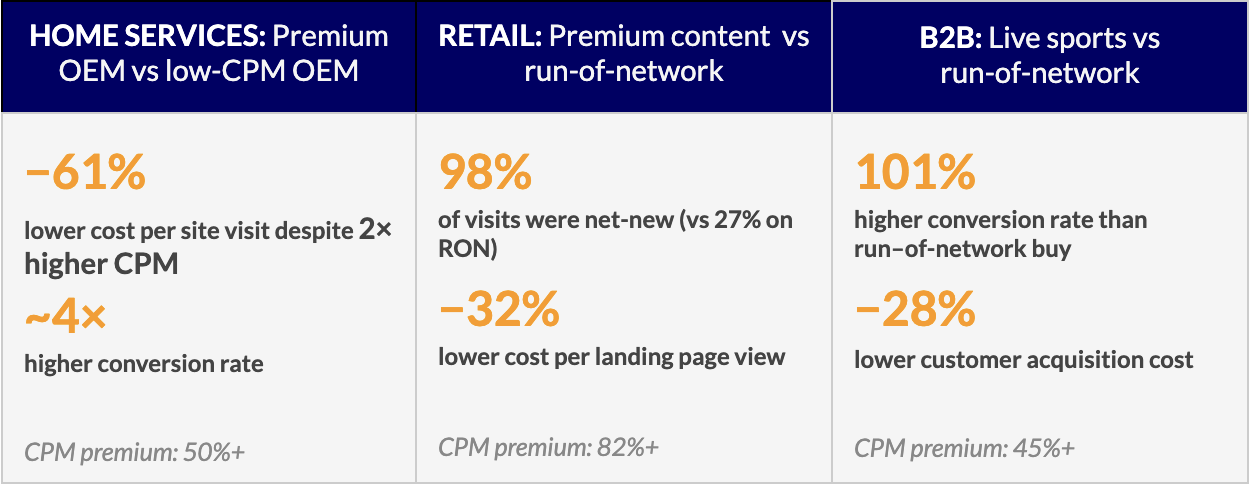
Does a lower cost per impression lead to a lower cost per customer? We tested that across three client categories. Every time, the answer was no, because the plan left out the placements where people were actually paying attention.
Business Problem
CPM is a useful planning metric, but it should not make the decision on its own.
When media plans are built mainly around the cheapest impressions, they often leave out the placements where people are most likely to pay attention and act.
Think about when your own attention is highest: live sports, the show you watch every week, a major cultural moment. Advertising in those environments costs more. The stronger engagement is often exactly why that premium is worth paying.
Scale Marketing builds plans with a mix of lower-cost, mid-tier, and premium inventory, then adjusts based on performance. We noticed the same problem appearing across three separate clients. Plans built too heavily around CPM missed the inventory that actually produced results.
The Evidence
Scale’s Approach
The Process
What we saw: We ran premium inventory next to lower-cost inventory. We kept targeting, geo, and all other settings the same and then compared the results.
What the data showed: Premium inventory consistently outperformed lower-cost inventory. It delivered stronger results on the client’s key metrics. These included cost per acquisition, conversion rate, and incremental reach.
What we did next: Moved more budget toward the inventory that was working. Performance improved, and cost per result lowered.
Why it Happens
Live sports, relevant programming, and other premium placements often come with higher costs because viewers are more engaged with the content.
But a higher CPM can still deliver better value for your business.
A low-cost impression that is ignored or reaches the wrong audience may look efficient in a spreadsheet, but that efficiency disappears when you measure the actual result. Media efficiency should be judged by the outcome it drives, not the cost of the impression alone.
That does not mean lower-CPM inventory should be removed from the plan. It still plays an important role in building reach and managing frequency. The goal is to balance cost-efficient scale with premium placements that can work harder.
How Scale Thinks About It
- Let the business goal drive the budget, not the CPM. Define what success looks like before the campaign launches: cost per acquisition, cost per site visit, incremental reach. Then test across inventory types and let the results, not the plan, decide the allocation.
- Give high-attention moments a seat at the table. Live sports, premium content, and brand-safe placements are often the easiest items to cut in CPM-first talks. The data says they’re often where the audience is most engaged and most likely to act.
- Content alignment is a targeting decision. The program, platform, and moment can do real work toward reaching the right audience on their own. When the content already aligns closely with that audience, extra targeting layers can add cost without adding performance.
- ACR data can make CTV genuinely incremental. We used ACR (automatic content recognition) data to exclude households already reached through linear TV from the CTV audience with one of our home services clients. That kept the CTV impressions incremental to the broader TV plan and reached households that linear TV wasn’t reaching.
In other cases, overlap between linear and CTV is intentional. CTV can add frequency across both environments when the audience strategy calls for it.
The Bottom Line
At Scale, premium inventory earns its place in the plan through performance, not its price tag.
We test it, compare the results against the cheaper alternative, and move the budget toward whatever wins. Across three clients, the conclusion held every time: the cheapest impression was not the cheapest way to get the result. CPM matters. The business outcome matters more.
Contact Us
We’d love to talk and understand your business.