“Is TV still worth it?” is one of the first questions we hear when clients start planning a new year. Our answer is still yes. What’s changed is everything around it.
Viewers haven’t stopped watching. They’ve just moved. Linear no longer owns the evening, and attention is now split across streaming, YouTube, social video, and the phone in their hand. Someone might catch sports highlights on the kitchen TV at breakfast, watch a YouTube tutorial at lunch, scroll Reels between meetings, and stream a show at night while scrolling on their phone. The audience is still there, but it’s spread across more screens, more hours of the day, and more services than most media plans were built for.
This is the second post in our State of Media 2027 series. Here’s what the data says about video heading into 2027, and what we think it means for your plan.
1. No single platform owns the viewer
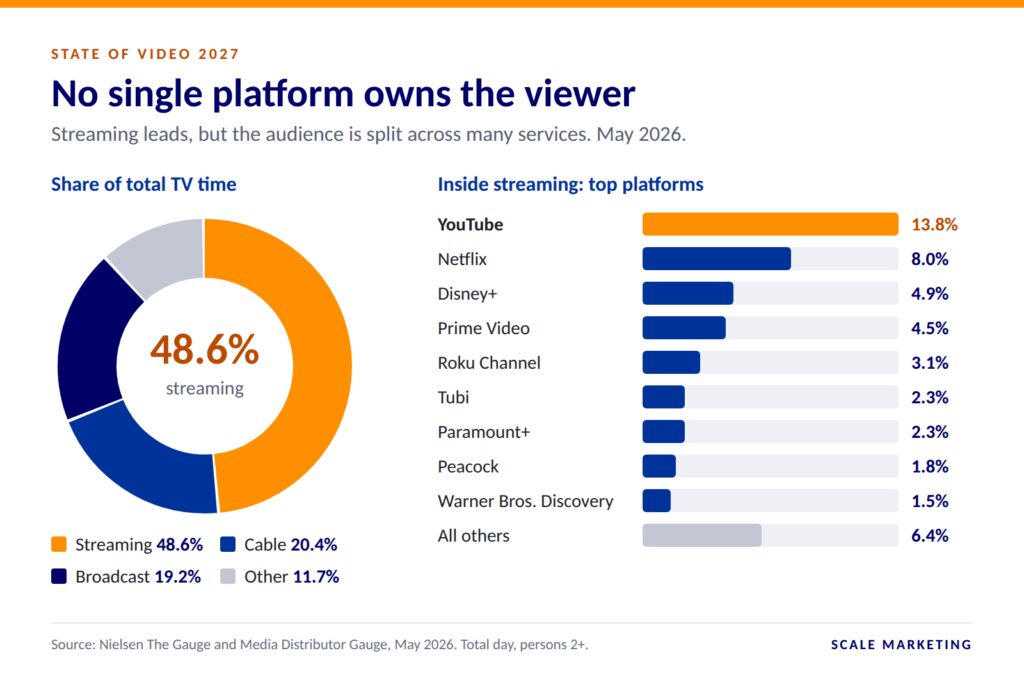
Streaming made up 48.6% of all TV time in May 2026, according to Nielsen’s The Gauge. Cable held 20.4%, and broadcast held 19.2%.
Inside streaming, the audience is split across a variety of options. YouTube leads at 13.8% of total TV time, well ahead of Netflix at 8.0%. After those two, there’s not a single platform that tops 5%.
2. Prime time is now all the time
Viewing used to peak in the evening. Now it runs all day, across every screen in the house.
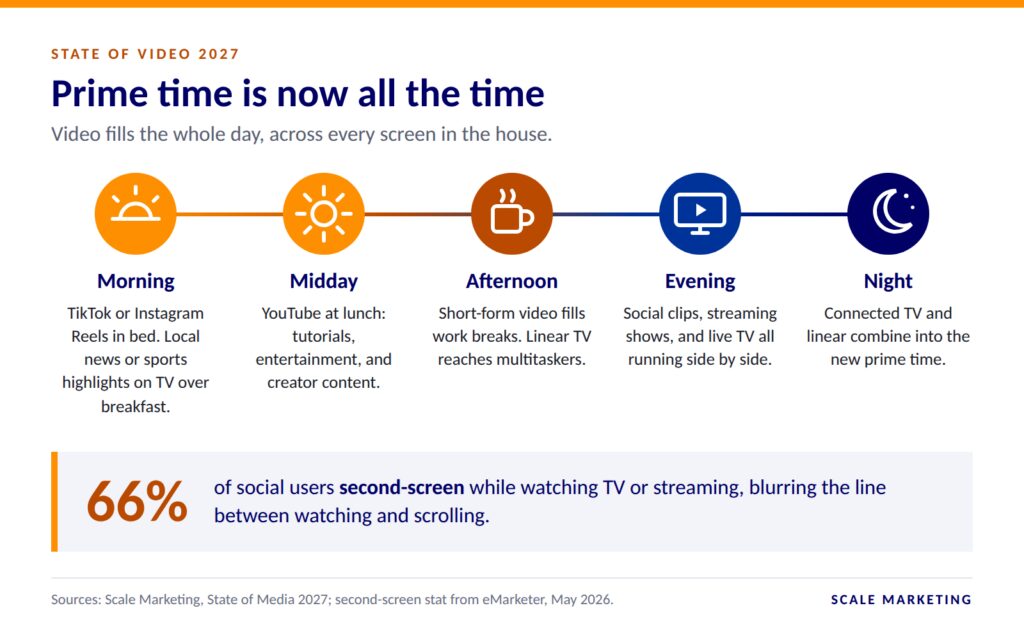 People are rarely stuck to one screen, either. 66% of social users second-screen while watching TV or streaming, according to eMarketer. The line between watching and scrolling keeps blurring.
That’s why we plan video as a single connected ecosystem rather than separate TV, social, and online video budgets. The message someone sees on the living room TV at night should connect to what they see on their phone the next morning.
3. Linear TV is shrinking on paper. Its reach is still hard to beat.
Linear TV keeps losing younger viewers. It also remains essential for live sports, news, and older audiences. Broadcast and cable together still reach about 70% of U.S. adults every month, according to Nielsen. Few options available to advertisers come close.
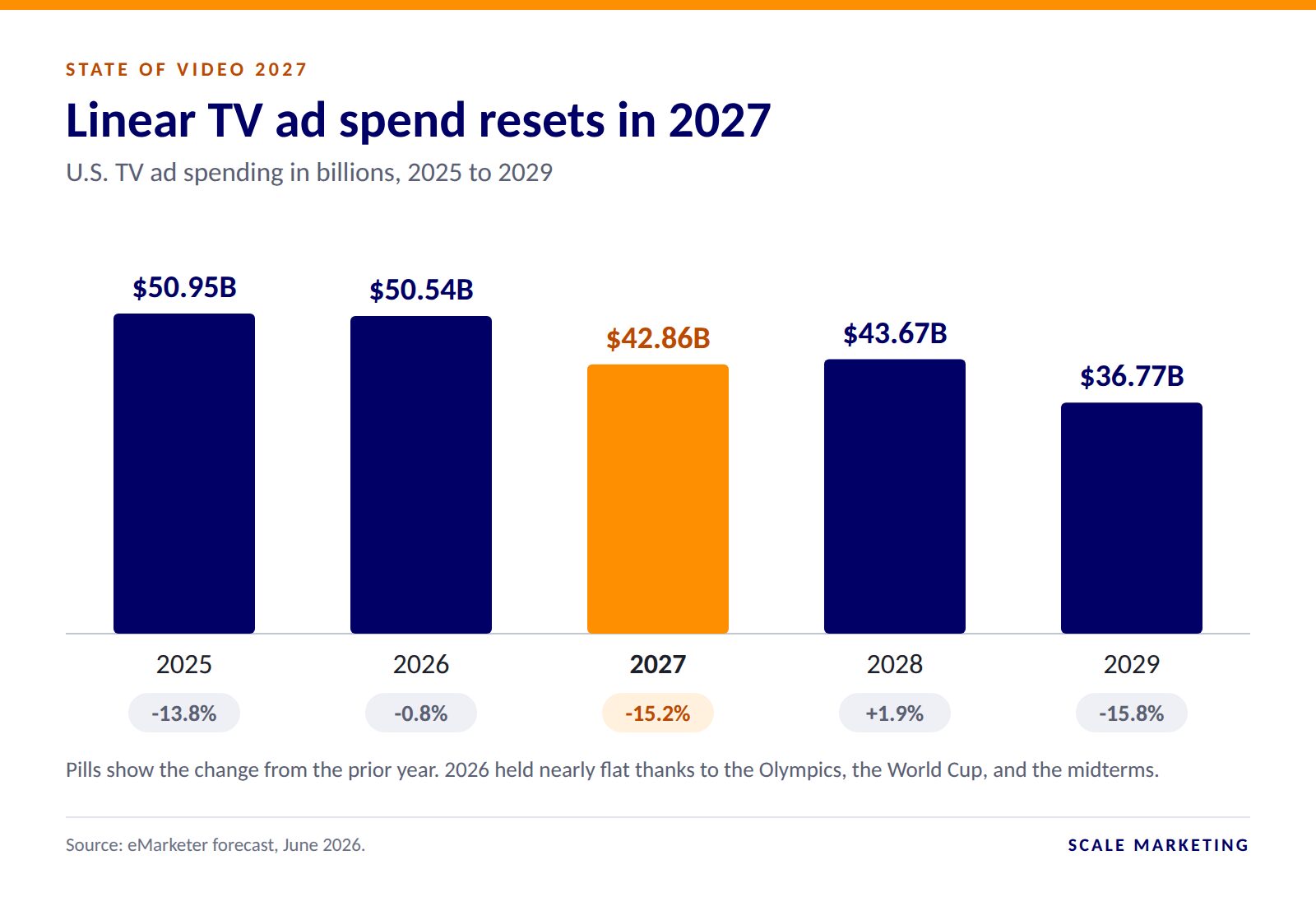
Spending tells a different story. eMarketer projects U.S. TV ad spend will fall 15.2% in 2027, to $42.86 billion. Part of that drop is a hangover.
2026 only stayed close to flat (down 0.8%) because significant events like the Olympics, the World Cup, and the midterms held it up.
4. Read your local TV numbers carefully this year
If your local TV reports suddenly look stronger, check the fine print before you celebrate.
Nielsen changed its local TV measurement rules in 2026. It bundled four changes into a single rollout, including a shorter viewing window, better in-room tracking, and corrected household data. Early data shows reported local impressions running 16% to 39% higher. The number of people truly watching hasn’t moved.
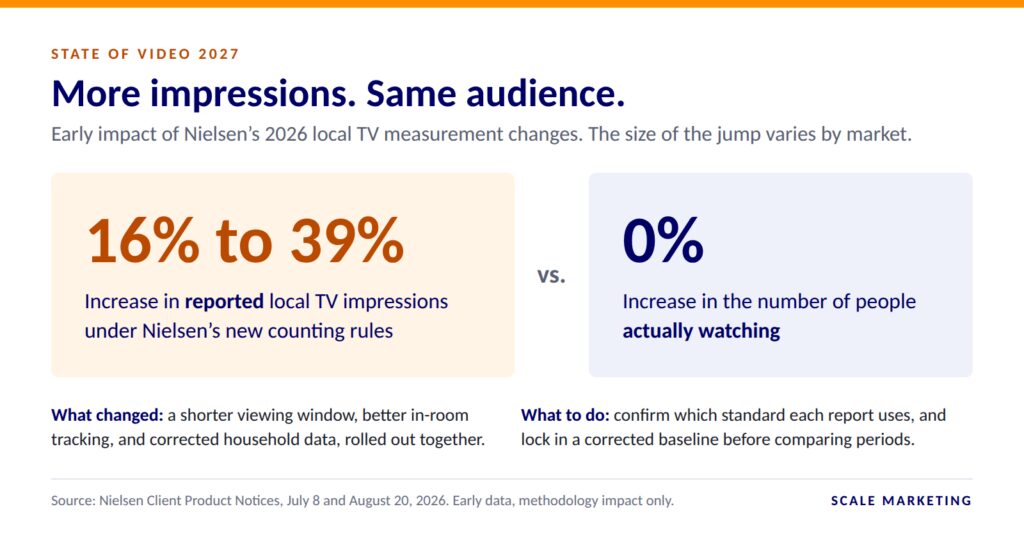 These are changes to how viewing gets counted, not audience growth. Before you compare a 2026 or 2027 schedule to past years, confirm which measurement standard each report uses. Then lock in a corrected baseline and plan from there.
5. CTV is a primary buy now
2026 was a turning point. For the first time, the upfront and NewFront cycle committed more to CTV than linear TV. That money is already funding programming into 2027.
Viewers are moving in the same direction. By 2027, ad-supported streaming viewers are expected to outnumber ad-free viewers roughly 4 to 1 (200.6 million vs. 45.9 million). By 2029, Amazon Prime Video, Hulu, Netflix, and Peacock are each projected to reach more than 100 million U.S. ad-supported viewers. That’s the real scale to plan against.
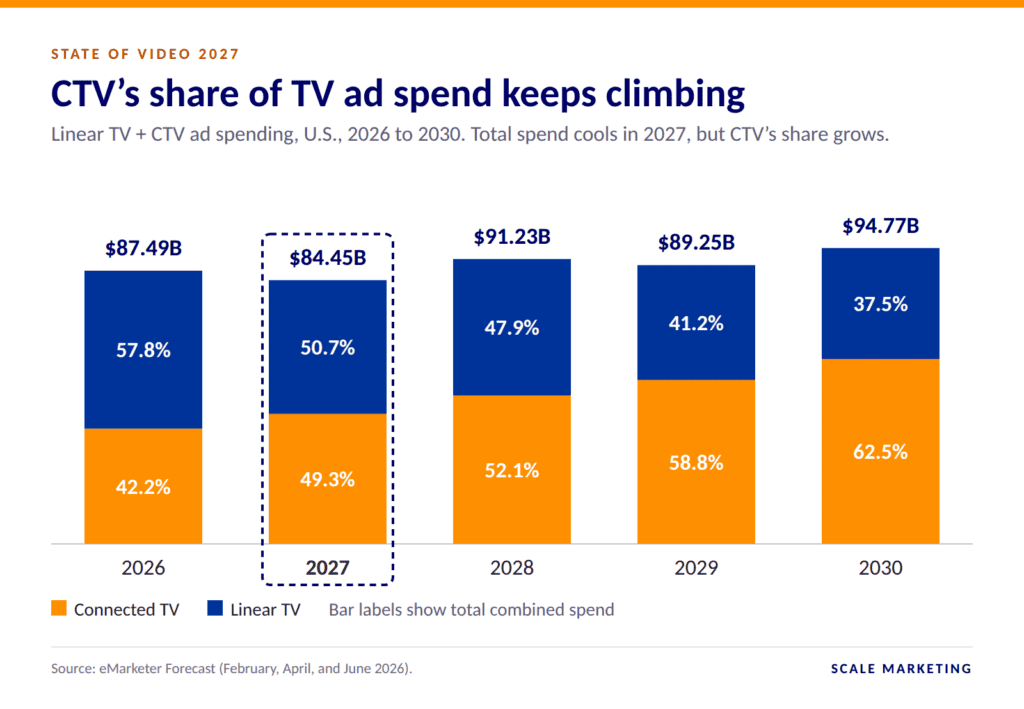
Combined TV ad spend cools off in 2027 after an inflated 2026. CTV’s share keeps climbing anyway, from 42.2% in 2026 to 49.3% in 2027 and 62.5% by 2030.
Our take: treat CTV as a core buy, not a test line. Budget it based on how your audience actually watches, not on a legacy split between linear and digital. If you’re still working out how to judge it, we covered that in our recent blog, Don’t Hold CTV to Standards You Never Applied to Linear TV.
6. YouTube is becoming TV
YouTube’s CTV ad business is more than twice the size of any competitor’s. It holds 25.5% of CTV ad revenue, compared with 12.0% for Amazon and 9.2% for Hulu and Disney+.
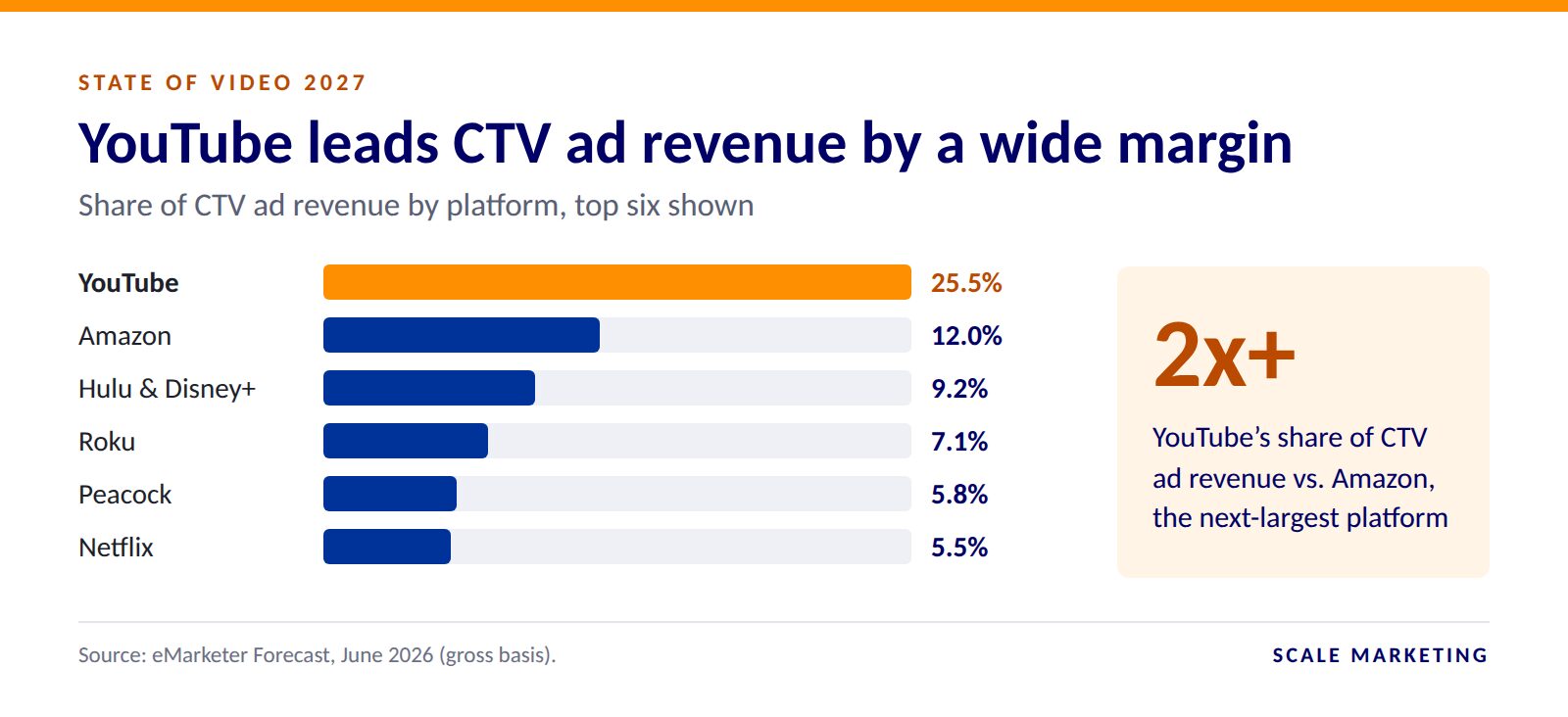
The TV screen is becoming YouTube’s main stage. About 75% of YouTube video ad spend ran on TV screens in Q2 2026. YouTube TV is already the third-largest pay TV provider in the U.S., with 9.3 million subscribers. And it’s on pace to become the largest by the end of 2027, passing Comcast and Charter.
YouTube now spans the whole funnel. TV-length formats like 30-second non-skippable ads and pause ads reach people in the living room. Shorts and creator content extend that reach, with Shorts alone hitting nearly 200 million U.S. users in 2026. Demand Gen campaigns, shoppable product tags, and QR codes on CTV ads aim to turn that interest into a purchase.
The money hasn’t followed that range yet. Skippable in-stream ads still account for 62% of YouTube ad spend, according to Tinuiti, with Shorts at 17%. And when it’s time to buy, shoppers still lean toward other platforms. In a February 2026 DHL survey, YouTube came in at 29%, behind Facebook (63%), TikTok (50%), and Instagram (48%).
So, we plan YouTube like TV, not as a stray line item in the search budget. It’s strongest at building reach and awareness. Search is still the better place to convert the demand it creates.
7. Sports keeps pulling more of the money
Sports took 39% of national linear TV ad revenue in 2025, up from 19% in 2017, and it’s projected to reach 42% in 2026. Big events like the Olympics give spending a short-term bump, but those figures leave that lift out. The climb is steady either way.
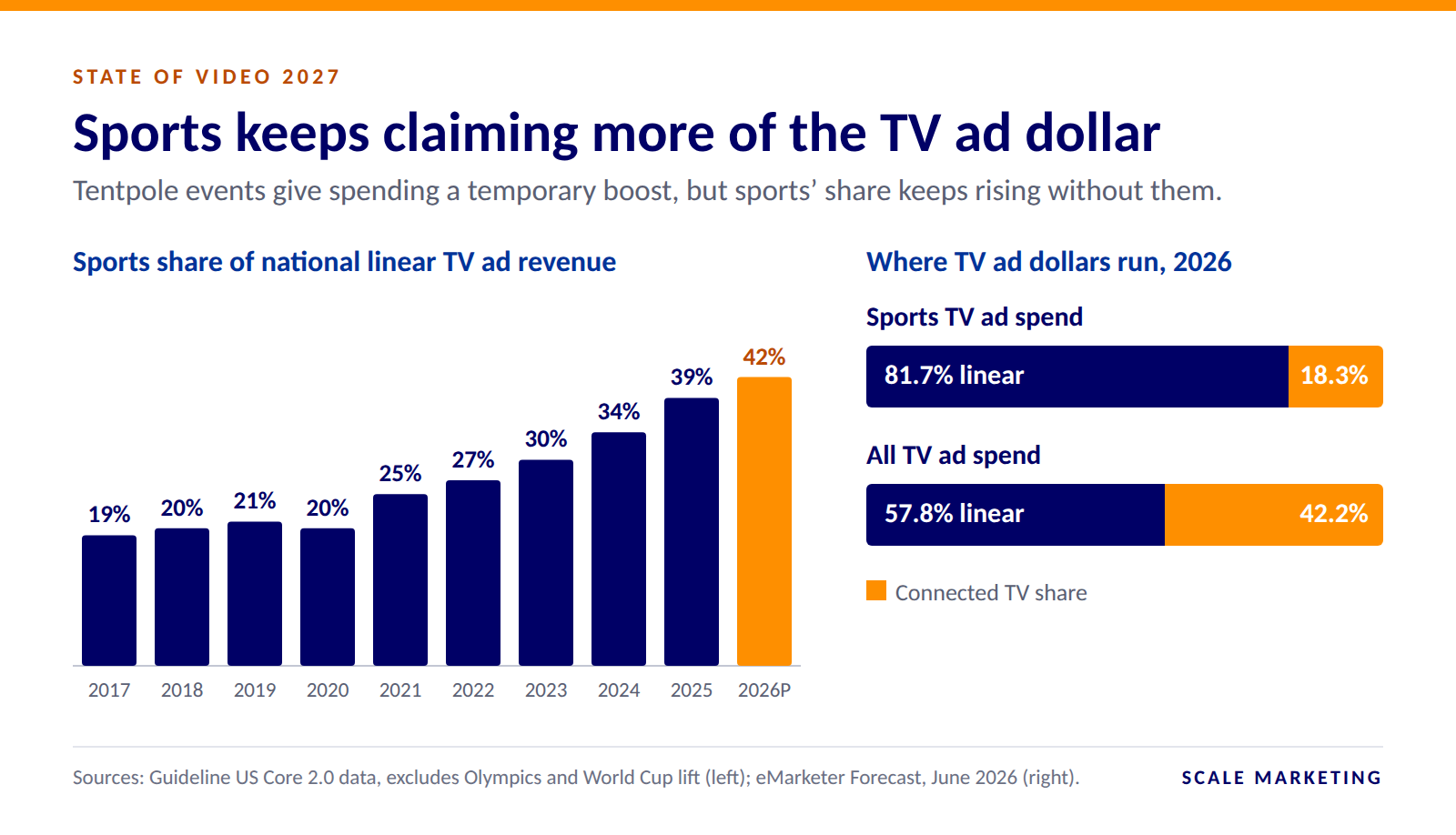
Sports is also where linear holds on the hardest. In 2026, about 82% of sports TV ad dollars went to linear, compared with 58% of TV ad dollars overall.
Fans are beginning to feel the shift. 65% say juggling multiple streaming services is a hassle. Additionally, 52% say it’s gotten more confusing to find the sports they want to watch. Both of these statistics are from Hub Research.
For advertisers, that fragmentation opens doors. Live sports CPMs run high, but shoulder programming and lower-profile sports can reach the same fans for less. Highlights and social clips reach them, too.
What we learned testing live sports
We put the premium to the test in a 2026 client campaign, comparing live sports placements against run-of-network (RON) buys.
Live sports cost 45% more per thousand impressions. It also delivered a 101% higher conversion rate and a 28% more efficient cost per acquisition.
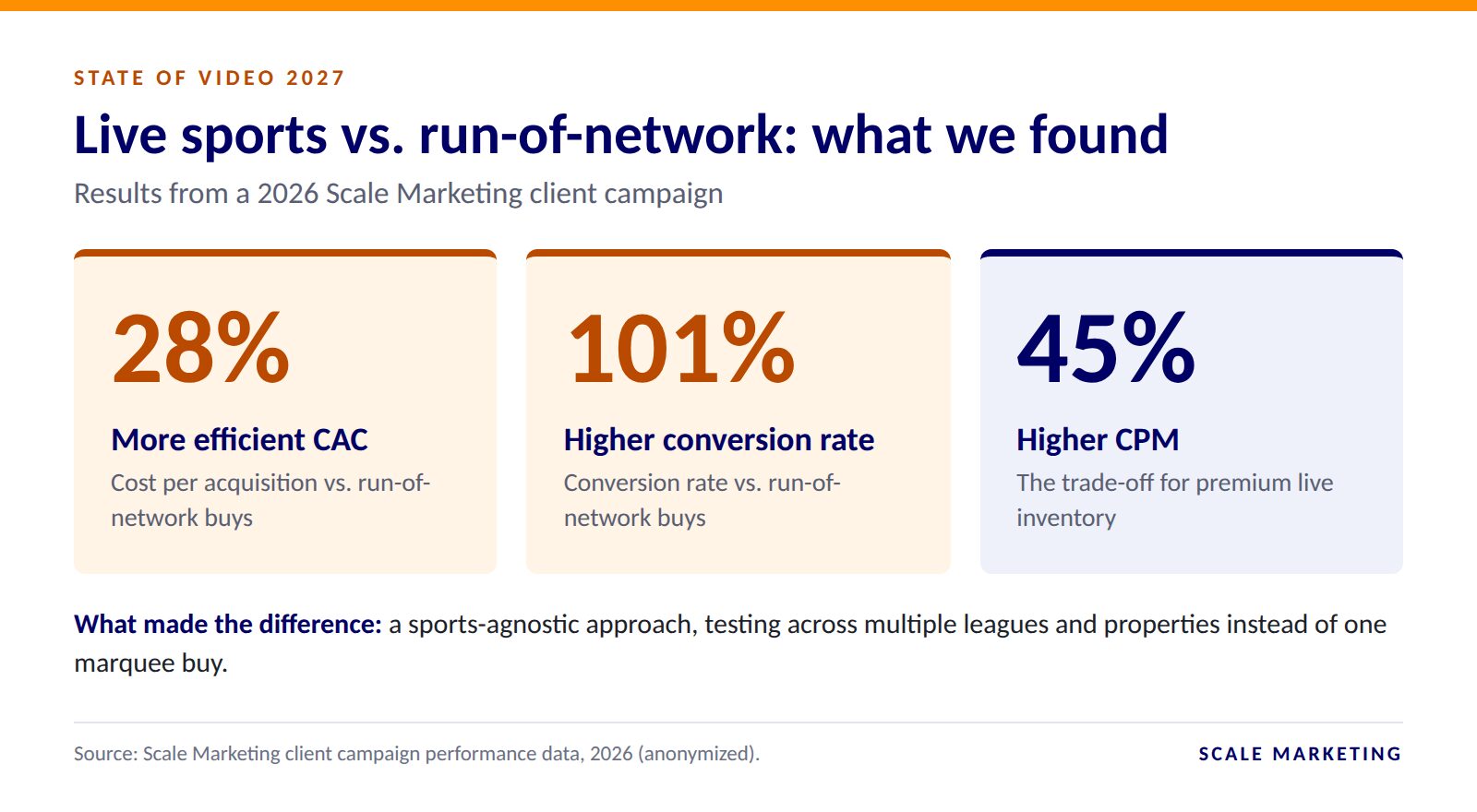
The biggest gains came from a sports-agnostic approach: testing across multiple leagues and properties rather than betting on one marquee buy. Live sports viewers are highly engaged, and that attention converted.
The takeaway: don’t shy away from a higher CPM when attention is what drives results. Live sports belongs in the CTV mix, balanced against your overall CPM. For more on where sports is heading on CTV, check out our blog, Beyond the Big Game: CTV’s Next Play in Live Sports.
What this means for your 2027 plan
- Plan for every screen, all day. Map video to how your customer moves through the day, and connect the message from the TV to the phone.
- Keep linear where it earns its place, especially for live sports, news, and older audiences. Pair it with CTV to protect total reach.
- Treat CTV and YouTube as core buys, each with its own budget and goals.
- Lock in a clean baseline before you compare local TV results year over year.
- Test live sports with an open mind. A higher CPM can still mean a lower cost per acquisition.
Quick answers to common video questions
Is linear TV still worth buying in 2027? For many brands, yes. Broadcast and cable still reach about 70% of U.S. adults each month, and linear is still the main home of live sports and news. It works best paired with CTV.
Why are my local TV impressions up? Most likely because of Nielsen’s new local measurement rules, not because more people are watching. Early data shows reported impressions up 16% to 39% with no change in actual viewers.
Should YouTube come out of my search budget? That’s not what we usually recommend. About 75% of YouTube video ad spend now runs on TV screens, so plan and measure it like TV, and let search convert the demand it creates.
One screen doesn’t own your customer anymore
The brands that win in 2027 will plan video the way people actually watch it: all day, across every screen, with one connected message.
If you’d like to talk through what this means for your plan, let’s talk.
Next in our State of Media 2027: State of Audio 2027: Everyone’s Listening