Audio often gets planned on autopilot. Radio typically reaches older listeners; podcasts and streaming reach younger ones. This split barely changes from year to year.
The 2026 data says it’s time for a fresh look. Podcasts and streaming are beginning to reach older listeners at record levels. Radio is still the biggest ad-supported audio channel, and more marketers plan to increase audio spend than at any point in the last two years.
This is the third post in our State of Media 2027 series. If you missed the last one, start with State of Video 2027. Here’s what’s changing in audio, and what we think it means for your 2027 plan.
1. AM/FM radio still carries the most weight
AM/FM radio accounts for 62% of daily ad-supported audio time among U.S. adults, according to Nielsen’s The Record. Podcasts hold 20%, streaming music 16%, and satellite radio 2%. These numbers only cover ad-supported listening, so subscription and ad-free services are not included here.
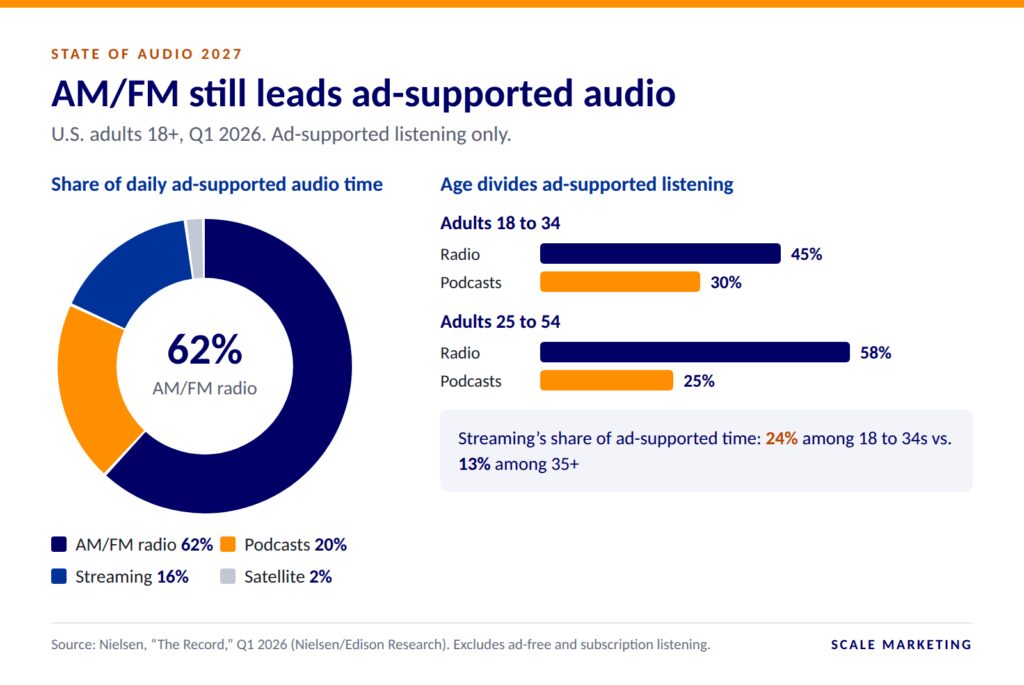
Younger listeners split their time more evenly. Adults 18 to 34 give radio 45% of their ad-supported listening time and podcasts 30%. Among adults 25 to 54, it’s 58% radio and 25% podcasts. Streaming makes up 24% of younger listeners’ ad-supported time, compared with 13% for listeners 35 and older.
The takeaway is simple. A buy that pairs radio with podcasts or streaming reaches the large majority of the ad-supported audio audience.
2. Radio’s reach is real, and uneven
The car is still radio’s home turf, but who’s driving makes a big difference. 81% of listeners 55 and older use AM/FM in the car each week. With our 18-to 34-year-old demographic, it’s 65%, and more of them use digital audio (73%) on that same drive.
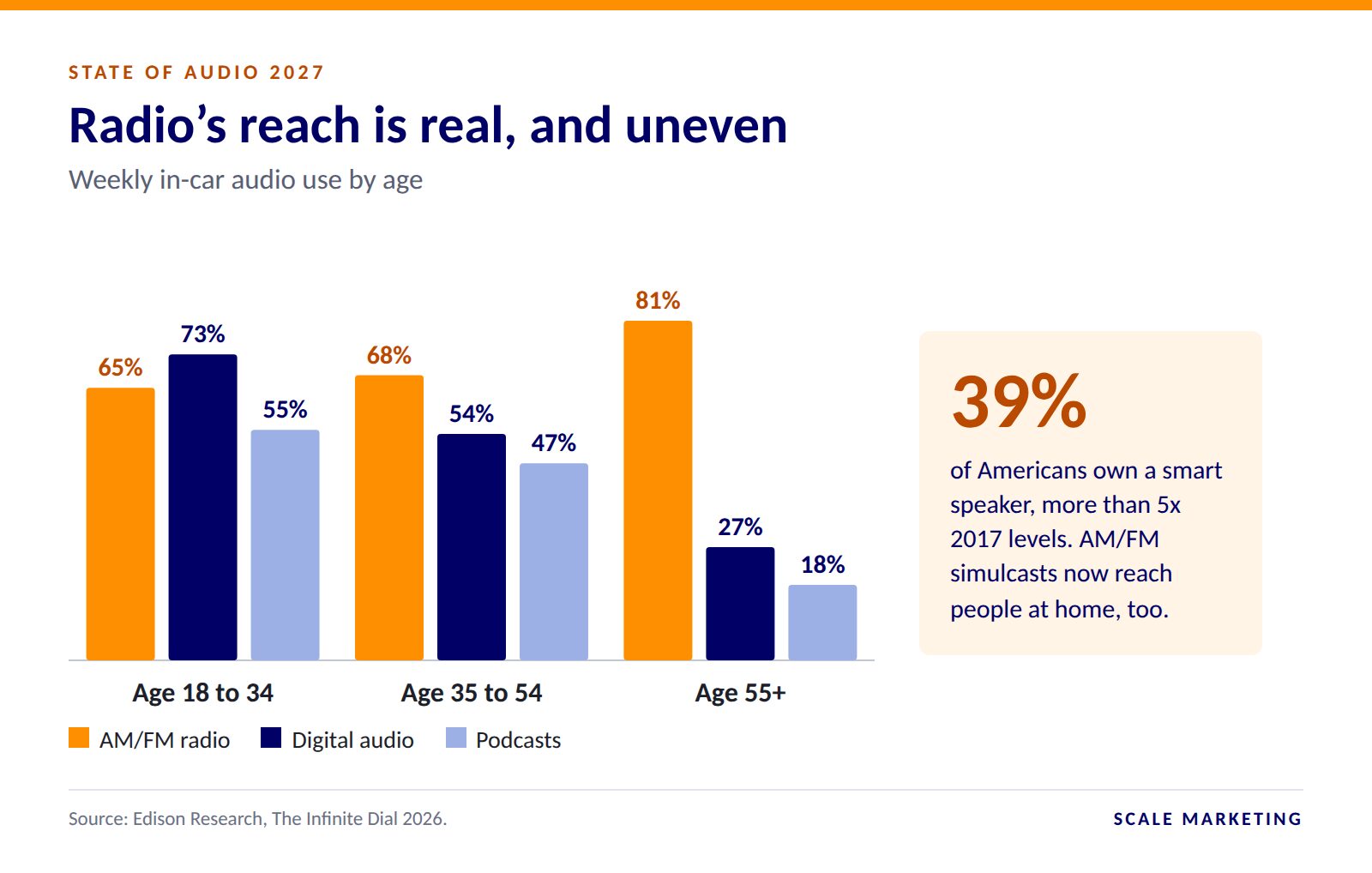
Radio has moved into the house, too. 39% of Americans now own a smart speaker. This is more than five times as many as in 2017, so AM/FM’s streamed simulcasts reach people at home, not just behind the wheel.
That’s why we weight radio buys by the age of our clients’ customers and pair broadcast with the digital simulcast to cover younger listeners.
3. Marketers are turning the dial back up
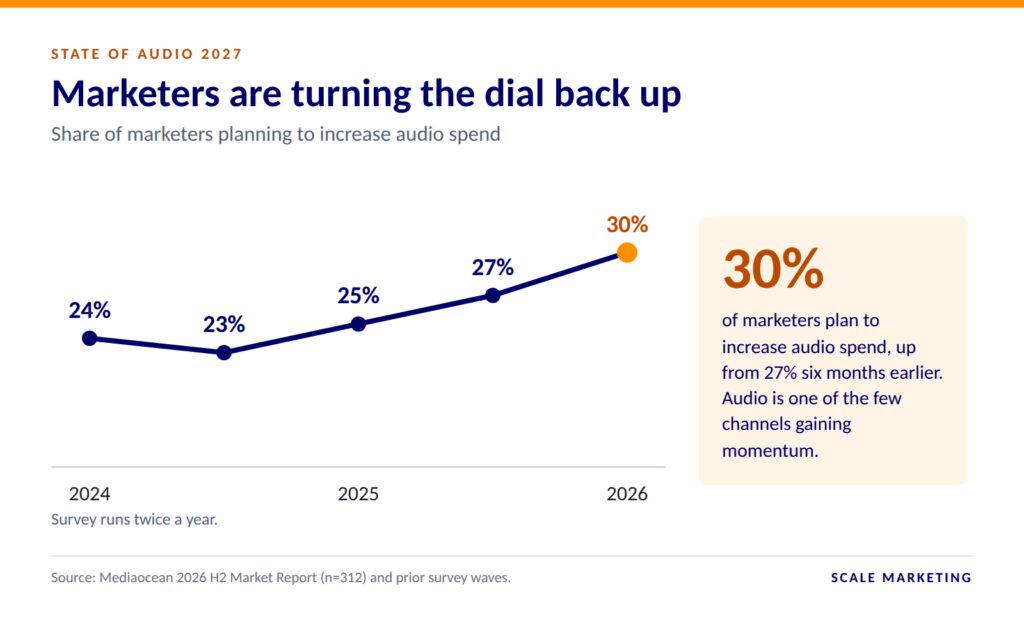
After a dip, audio is regaining favor with marketers. In Mediaocean’s latest survey of 312 marketing professionals, 30% plan to increase audio spend. This is up from 27% six months earlier and 23% at its recent low. Few channels are gaining momentum like that right now.
The audience is there to back it up. 58% of Americans now listen to podcasts monthly, an all-time high, according to Edison Research.If you’ve been looking for the right time to make the case for more audio in your marketing budget, this is a good one.
4. Streaming audio keeps growing, especially with older listeners
81% of Americans 12 and older now listen to online audio monthly, which is up from 73% in 2022. That includes AM/FM streamed online and internet-only services, equaling about 233 million monthly listeners in all.
Data shows that Spotify (36%) and YouTube Music (34%) are the most-used brands, followed by Pandora (21%), Amazon Music (19%), and Apple Music (17%).
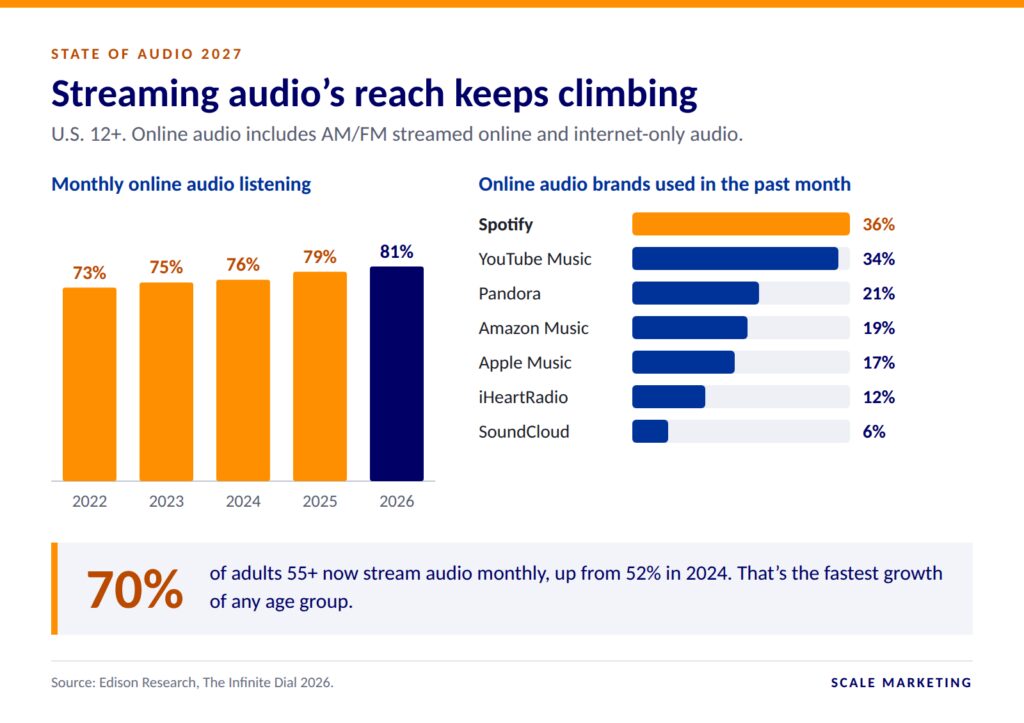
The biggest change is who’s listening now. 70% of adults 55 and older now stream audio monthly, a rise up from 52% in 2024. That’s the fastest growth of any age group. Listening among 12-to 34-year-olds and 35-to-54 year-olds has been essentially flat.
If your targeting plan still treats streaming audio as a young person’s channel, it’s worth another look.
5. Streaming audio is becoming a programmatic buy
How streaming audio gets bought is changing as fast as who’s listening. About 40% of Spotify’s ad-supported revenue now comes through automated, programmatic buying, even as its overall ad growth slowed to 1% in Q2. Pandora’s ad revenue is growing again, up 5%, according to SiriusXM’s Q2 2026 results.
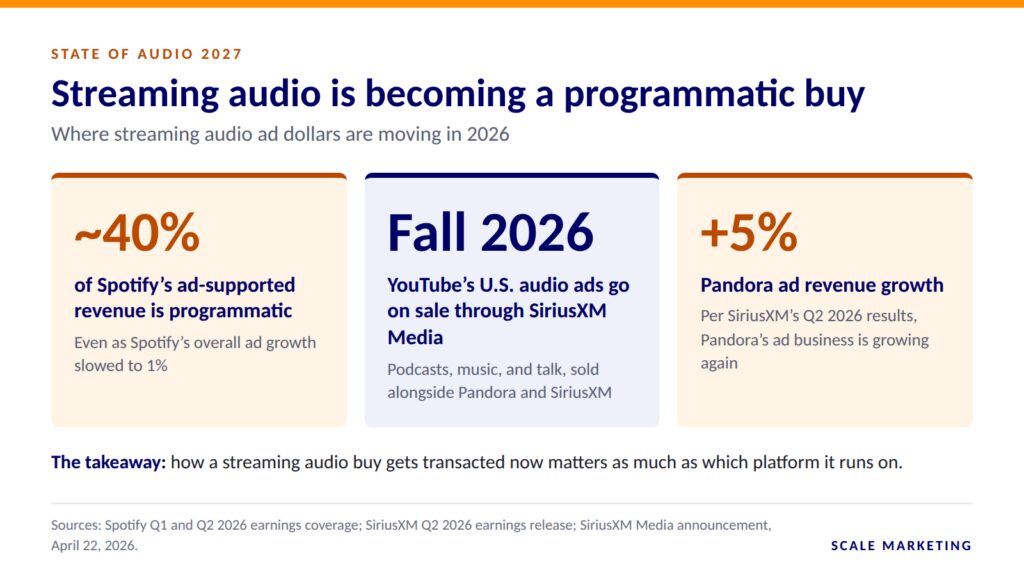
The biggest news is YouTube. In April 2026, SiriusXM Media became the exclusive U.S. ad sales partner for YouTube’s audio inventory, including podcasts, music, and talk content. With inventory rolling out this fall, advertisers can buy it in the same place they buy Pandora and SiriusXM.
For 2027, we’re planning streaming audio the way we already plan CTV. We’re buying programmatically, optimized in real time, and with frequency that’s managed across platforms, rather than negotiated as a single fixed placement.
How a buy gets transacted now matters as much as which platform it runs on.
6. The podcast audience grew up
Podcasts used to be a young person’s medium. That’s no longer true.
68% of Americans 35 to 54 now listen to podcasts monthly, edging past even the 64% of 12 to 34s, the age group that used to define the format. Among Americans 55 and older, monthly listening has now reached 44%. This is more than double the 21% of three years ago.
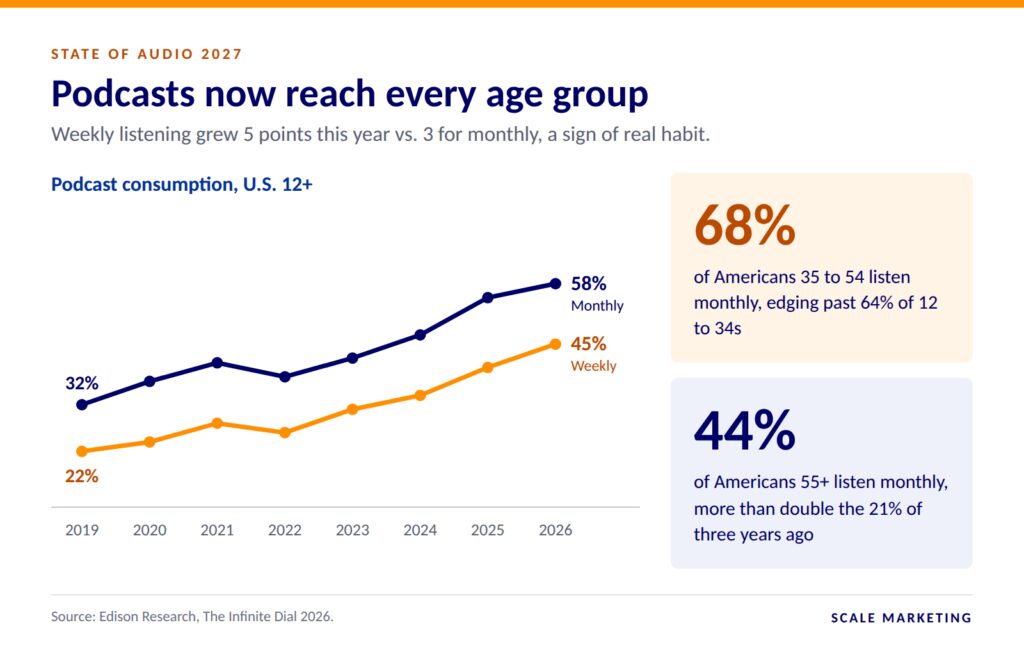
Overall, monthly podcast listening climbed from 32% of Americans in 2019 to 58% in 2026. Weekly listening is growing even faster. It rose five points this year, compared with three for monthly listening. People aren’t just sampling podcasts. They’re building them into their routines.
For clients already investing in audio, we treat podcasts as a core part of the plan. Their reach now spans every age group.
7. Three platforms control most podcast listening
YouTube (32%), Spotify (25%), and Apple (20%) account for 77% of daily podcast listening time. Everything else splits down a long and fragmented tail.
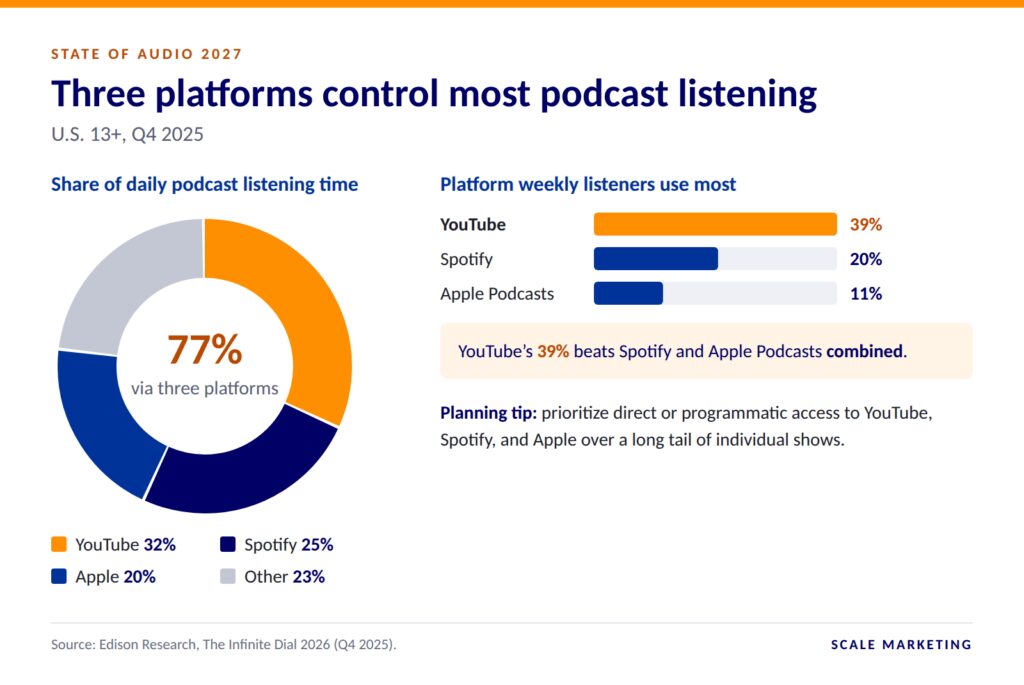
YouTube’s lead is even clearer when you ask listeners directly. 39% of weekly podcast listeners say YouTube is the platform they use most. This is more than Spotify (20%) and Apple Podcasts (11%) combined.
That concentration makes podcasts easier to buy at scale. Instead of buying show by show, prioritize direct or programmatic access to YouTube, Spotify, and Apple. With YouTube’s audio inventory now sold through SiriusXM Media, there’s one more route to the biggest platform.
What this means for your 2027 plan
- Weight audio buys by your customer’s age, not by old assumptions about who listens where.
- Pair AM/FM with its digital simulcast to reach listeners in the car and at home.
- Make podcasts a core part of the mix, with access through YouTube, Spotify, and Apple.
- Buy streaming audio the way you buy CTV: programmatically, with frequency managed across platforms.
- Use the momentum. Audio is gaining marketer conviction, so now is a good time to test incremental budget.
Quick answers to common audio questions
Is radio still worth buying in 2027?
Yes. AM/FM still accounts for 62% of ad-supported audio time, and 81% of listeners 55 and older tune in from the car each week. Pair it with streaming to reach younger listeners.
Are podcasts only for younger audiences?
Not anymore. 68% of Americans 35 to 54 and 44% of those 55 and older listen monthly.
What’s the most efficient way to buy podcasts?
Go through the platforms that carry most of the listening. YouTube, Spotify, and Apple account for 77% of daily podcast time, and you can reach them directly or programmatically.
Give audio a fresh look
Audio reaches more people, across more ages and more platforms, than most plans give it credit for. And it’s getting easier to buy at scale. The brands that get the most out of audio in 2027 will plan around who’s actually listening today.
If you’d like to talk through what this means for your plan, let’s talk.
Next in our State of Media 2027 series: State of Search & AI