Search worked about the same way for years. Someone typed a few words into Google, scanned a page of links, and clicked one. If you ranked near the top, or paid to be there, you got the visit.
That’s not how a growing share of searches play out anymore. People ask full questions, often to an AI tool, and get a single answer back, while many never click at all.
People are still searching, though. And when someone needs a plumber tonight or a lawyer this week, they still pick up the phone. What’s changed is who gets found first, and what it takes to get there.
This is the fourth post in our State of Media 2027 series. If you missed the last one, start with the State of Audio 2027. Here’s how AI search is changing the picture, and what we think it means for your 2027 plan.
1. More searches start with AI
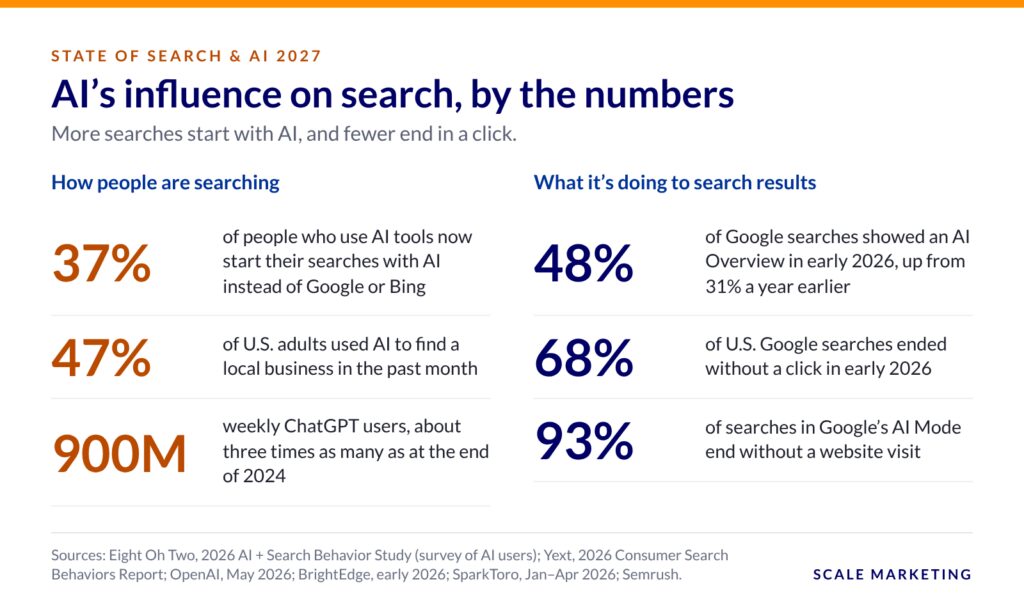
AI tools are now part of how people look things up. Among people who use AI tools, 37% now start their searches with AI instead of Google or Bing, according to Eight Oh Two’s 2026 study. ChatGPT alone has more than 900 million weekly users, about three times as many as at the end of 2024.
It’s not just for research and recipes, either. 47% of U.S. adults used AI to find a local business in the past month, according to Yext, and seven in 10 people who use AI say they use it more than they did a year ago.
Google is building AI into its own results, too. AI Overviews, the AI-written summaries at the top of the page, appeared on 48% of the searches BrightEdge tracked in early 2026, up from 31% a year earlier.
Here’s the part that matters most for local businesses: AI hasn’t replaced Google. In BrightLocal’s 2026 research, 75% of people who used AI to find a local business checked Google or Google Maps before reaching out. AI is often where the search starts. Google is still where many of the decisions get made.
2. Fewer searches end in a click
68% of U.S. Google searches ended without a click in early 2026, according to SparkToro and Similarweb. The answer was right there on the page, in an AI Overview, a map, or a quick snippet, so people didn’t feel the need to go any further.
Google’s AI Mode, which is its chat-style search, goes even further. Semrush found that about 93% of AI Mode searches end without a visit to any website. AI Mode remains a small share of searches today, but Google announced in the spring that it’s bringing AI Mode and AI Overviews together. You should expect more of that experience in everyday results.
Fewer clicks doesn’t mean less competition. It means more competition for the clicks that are left. This is what’s pushing costs up. In WordStream’s latest benchmarks, the average cost per click for home and home improvement businesses rose about 6% year over year. (We dig into rising search costs in our Cost Shock blog.)
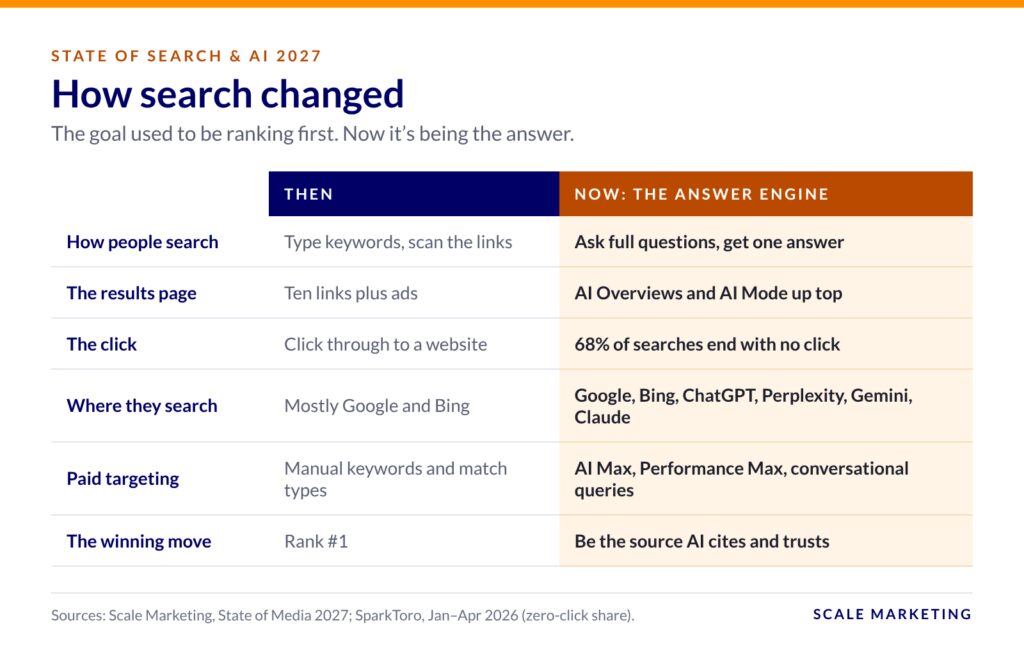
The goal used to be ranking first. Now it’s being the source that Google and AI tools trust enough to show.
3. Local, high-intent searches still drive calls
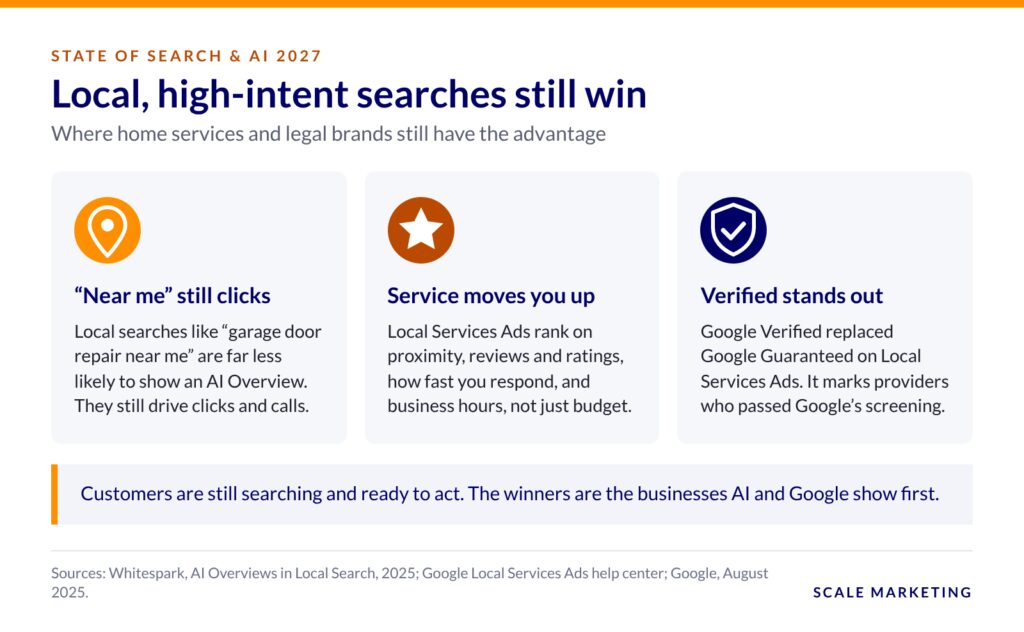
There is good news for home services and legal brands. When someone searches “water heater repair near me” or “car accident lawyer,” they don’t want a summary. They want someone to call.
Those searches are far less likely to show an AI Overview. In Whitespark’s study of local business searches, AI Overviews appeared on about 15% of local-intent searches. This was compared with 92% of informational ones. The map pack, Local Services Ads, and paid search still lead the results and continue to drive clicks and calls.
Local Services Ads deserve a closer look. Google ranks them on proximity, reviews and ratings, how quickly a business responds to customers, and business hours. Budget matters, but it isn’t the only lever, so a business that responds quickly and maintains strong reviews gives itself a real edge. Google has also replaced its Google Guaranteed badge with Google Verified, which marks providers that have passed Google’s screening.
4. Streaming audio keeps growing, especially with older listeners
81% of Americans 12 and older now listen to online audio monthly, which is up from 73% in 2022. That includes AM/FM streamed online and internet-only services, equaling about 233 million monthly listeners in all.
Data shows that Spotify (36%) and YouTube Music (34%) are the most-used brands, followed by Pandora (21%), Amazon Music (19%), and Apple Music (17%).
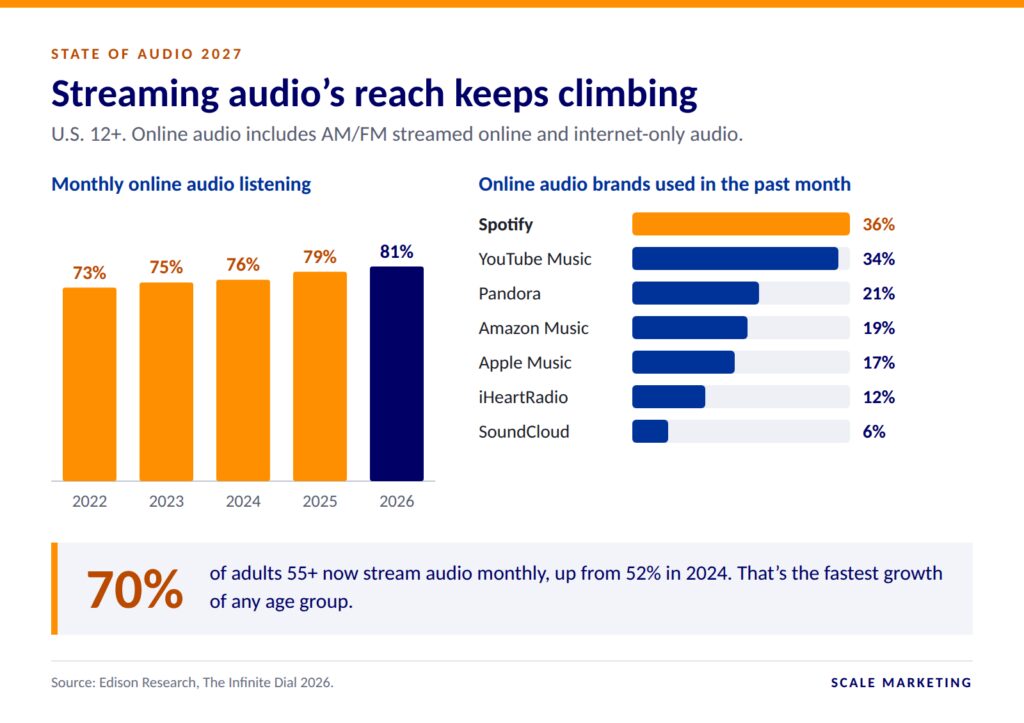
The biggest change is who’s listening now. 70% of adults 55 and older now stream audio monthly, a rise up from 52% in 2024. That’s the fastest growth of any age group. Listening among 12-to 34-year-olds and 35-to-54 year-olds has been essentially flat.
If your targeting plan still treats streaming audio as a young person’s channel, it’s worth another look.
5. Streaming audio is becoming a programmatic buy
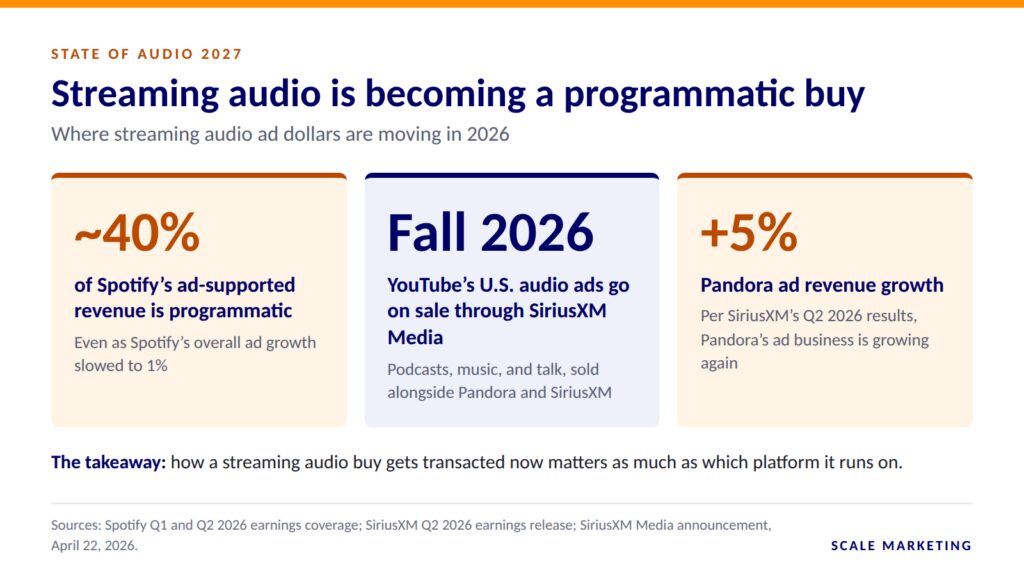
How streaming audio gets bought is changing as fast as who’s listening. About 40% of Spotify’s ad-supported revenue now comes through automated, programmatic buying, even as its overall ad growth slowed to 1% in Q2. Pandora’s ad revenue is growing again, up 5%, according to SiriusXM’s Q2 2026 results.
For our home services and legal clients, this is where Scale plays the most defense. We protect “near me” and service-plus-city searches, and keep Local Services Ads funded and monitored. We help clients stay on top of their reviews and response times that help decide who shows up first.
4. When clicks shrink, every visit counts more
If fewer people click, the ones who do are worth more. A landing page that converts 5% of visitors instead of 3% delivers about two-thirds more leads from the same traffic, without spending another dollar on media.
That’s why we treat conversion rate optimization (CRO) as a standing line item, not a one-time project. It starts with the basics: fast pages, a clear offer, a phone number that’s easy to tap, and forms that only ask for what you need. Then we keep testing.
Measurement matters just as much. Many home services and legal leads start with a phone call, so we connect call tracking and offline conversions (which calls became booked jobs or signed cases) back to the ad platforms. That way, their bidding tools optimize toward real customers, and not just form fills.
5. Being cited is the new ranking
When someone asks an AI tool about your category, does it mention you? For a growing share of searches, that’s the question that matters most.
Getting there goes by a few names, including answer engine optimization (AEO) and generative engine optimization (GEO). The fundamentals will sound familiar: clear answers to the questions customers actually ask, consistent business information across the web, structured data (schema) that helps machines read your pages, strong reviews, and mentions on the sites AI tools trust and pull from.
We now track AI citations and mentions as a core KPI alongside rankings and traffic. That way, we can see where a brand shows up in AI answers and where competitors are showing up instead.
On the paid side, Google’s AI-driven campaign types, like AI Max for Search and Performance Max, can find searches that keyword lists miss, especially longer, conversational ones. Left alone, they can also spend money in places you wouldn’t choose. So we don’t opt in blindly. Our search team adds them with guardrails, like brand and URL controls, negative keywords, and close review of the search terms they match to.
We also keep testing. Scale recommends running at least one live AI search test at any given time, whether that’s AI Max, Performance Max, or a newer option like ChatGPT ads. What we learn in one account makes the others better.
6. ChatGPT is now an ad platform
ChatGPT went from public launch to self-serve ad platform in less than four years. Ads arrived in February 2026 as a pilot with a six-figure minimum and a $60 CPM. By April, the minimum had dropped to $50,000. In May, OpenAI opened a self-serve Ads Manager with no minimum spend, cost-per-click bidding, and conversion tracking.
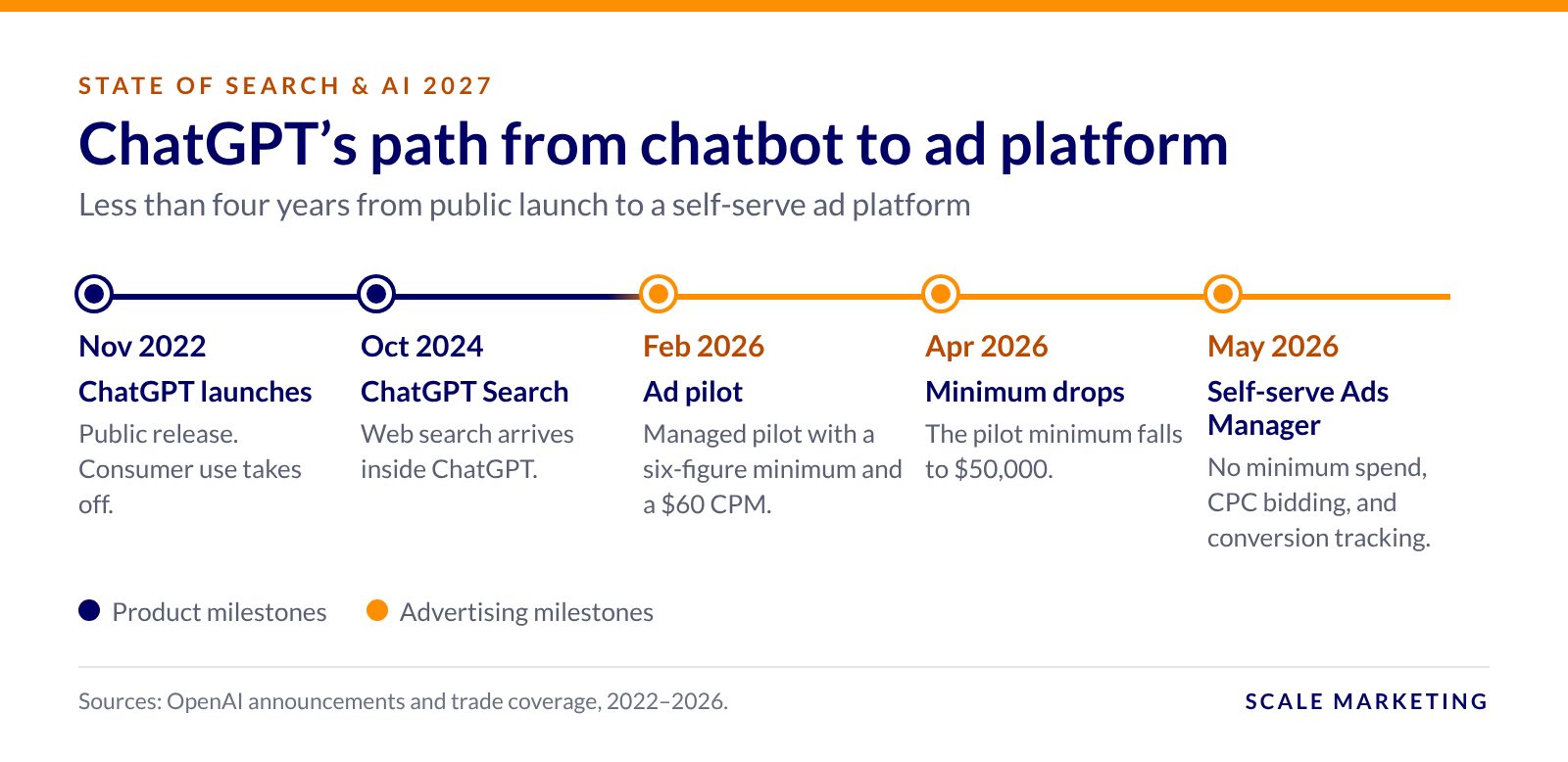
That’s fast, even by tech standards, and advertisers are paying attention. In Mediaocean’s latest survey, 60% of marketers said they plan to increase spending on AI media (ads on AI platforms and agents) in the second half of 2026, making it the fastest-growing category in the survey.
It’s also early, with targeting and reporting still taking shape and few benchmarks to go on. Our take: treat ChatGPT ads as a test for now, not a core channel. Start small, set up conversion tracking from day one, and judge results on leads and cost per lead, not clicks. If your customers already ask AI tools for recommendations, it’s worth learning how the channel works before your competitors do.
7. AI agents are coming to media buying, carefully
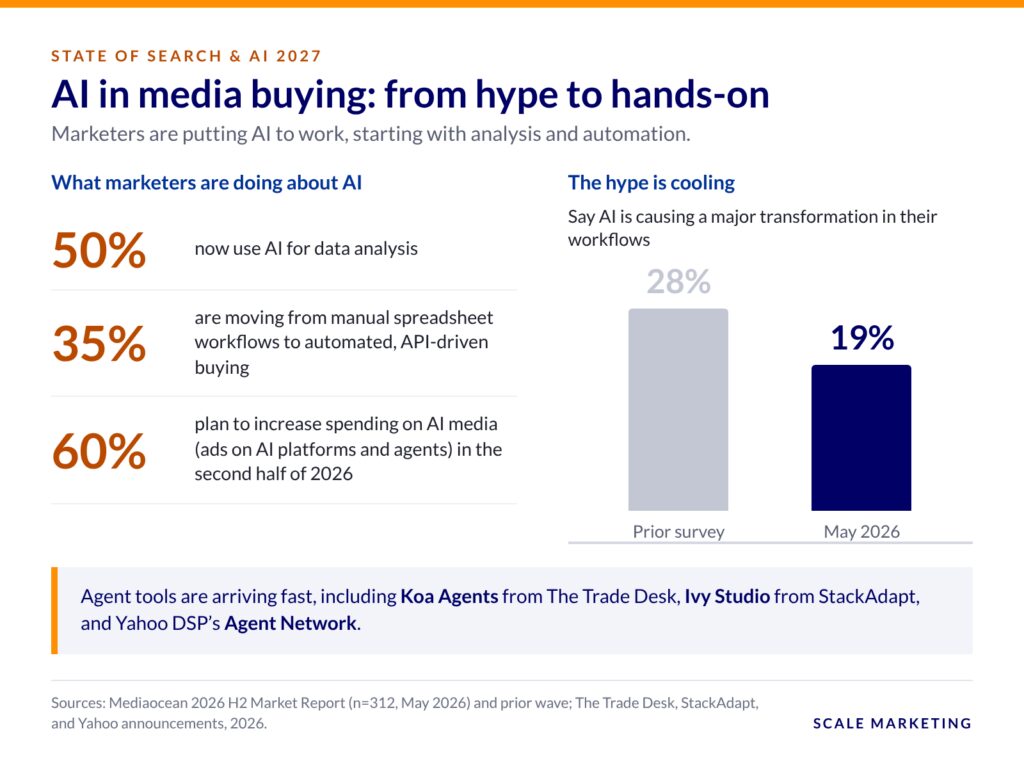
The next shift is agentic buying: AI agents that help plan, build, and adjust campaigns with less manual work. The big ad platforms are building them now, including The Trade Desk’s Koa Agents, StackAdapt’s Ivy Studio, and Yahoo DSP’s Agent Network.
Marketers are interested, but they’re moving carefully. In Mediaocean’s 2026 H2 survey of 312 marketers, half now use AI for data analysis, and 35% are moving away from manual spreadsheet workflows toward automated, API-driven buying. At the same time, the share who say AI is causing a major transformation in their workflows fell from 28% to 19% since the previous survey. The hype is cooling, and the practical work is starting.
Here’s how we’re approaching it. We build our own agents where the risk is lowest and the time savings are highest, like building traffic sheets, submitting work tickets, and post-buy reconciliation (confirming ads ran as ordered). That frees up our team for strategy, testing, and optimization, the work that moves results. Our people still decide where the money goes, and the quality of our work doesn’t change.
What this means for your 2027 plan
- Track AI visibility, not just rankings. Add AI citations and mentions to your reporting.
- Protect your high-intent searches. “Near me” and service-plus-city searches, Local Services Ads, and brand terms still drive calls. Keep them fully funded.
- Make CRO a standing line item. With fewer clicks, every visit is worth more.
- Connect calls and offline conversions. Send booked jobs and signed cases back to the platforms so bidding learns what a real customer looks like.
- Keep reviews and response times strong. They affect where you show up in Local Services Ads and what AI tools find when they look you up.
- Set aside a test budget for AI ad products. AI Max, Performance Max, and ChatGPT ads are worth testing with guardrails and clear success metrics.
Quick answers to common search and AI questions
Will AI search replace Google for my business?
Not anytime soon. AI tools are becoming a common starting point, but most people who use AI to find a local business still check Google or Google Maps before reaching out. Plan for both.
What are AEO and GEO?
Answer engine optimization and generative engine optimization. Both mean making your business easy for AI tools to find, understand, and cite, and both build on solid SEO fundamentals.
Should we advertise on ChatGPT?
It’s worth testing if your customers already use AI to research purchases. With no minimum spend and conversion tracking now available, a small, closely measured test is a reasonable place to start.
Be the answer they find
Search isn’t going away. It’s spreading out across Google, AI tools, maps, and ads, and fewer of those searches end in a click. The brands that do well in 2027 will protect the searches that drive calls, make every visit count, and show up where AI tools look for answers.
If you’d like to talk through what this means for your plan, let’s talk.
Next in our State of Media 2027 series: State of Digital