As brands plan for 2026, one factor will significantly shape the media landscape: the Midterm election cycle. Analysts expect political ad spending to reach record levels, creating meaningful pressure across key media channels. This is across the board: from television and connected TV to digital, social, and audio.
Understanding how political ads impact inventory, pricing, and performance is essential to protecting efficiency and maintaining visibility for advertisers. At Scale Marketing, we help brands navigate election cycles with clarity and confidence. Here’s what to know about and how to prepare for the 2026 media environment:
The 2026 Political Ad Spending Landscape
Political ad spending tends to rise during election years. This includes Midterm elections that typically have highly contested local, state, and federal races. In 2026, that trend will accelerate.
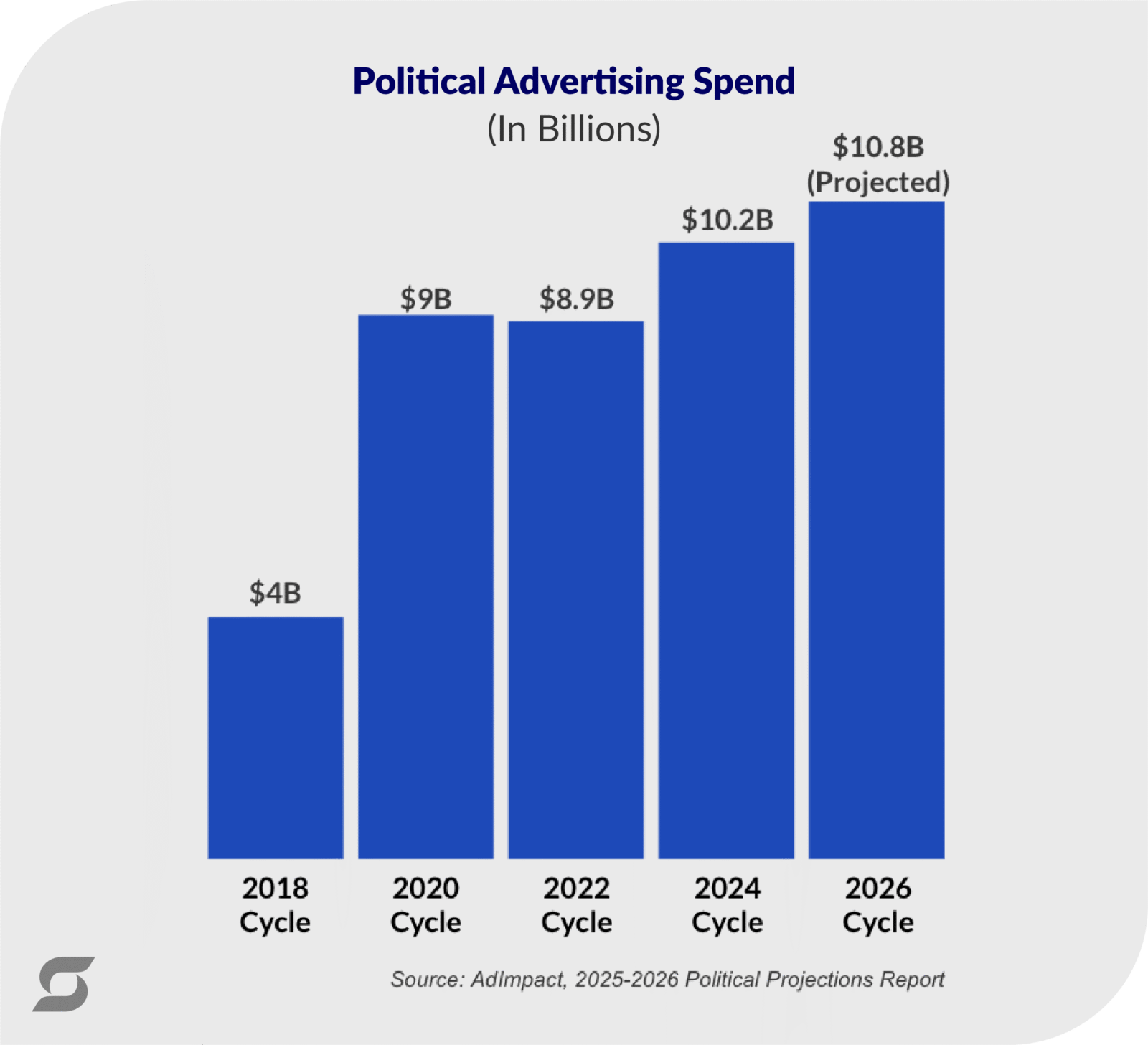
The 2026 Midterm elections are projected to be the most expensive on record. Analysts expect that total political ad spending will reach $10.8 billion. This is more than 20% higher than the 2022 Midterm cycle, which came in at a whopping $8.9 billion.
Analysts project that House and Senate races will generate $5 billion in combined spending. This will account for nearly half of all political ad spending this cycle. They also expect that many of the individual contests will exceed $500 million in spend.
Notably, political advertising activity is already ahead of pace. Through August 2025, officials had spent more than $900 million, significantly outpacing comparable points in 2021 and 2023.
Political Ad Spending by Media Channel
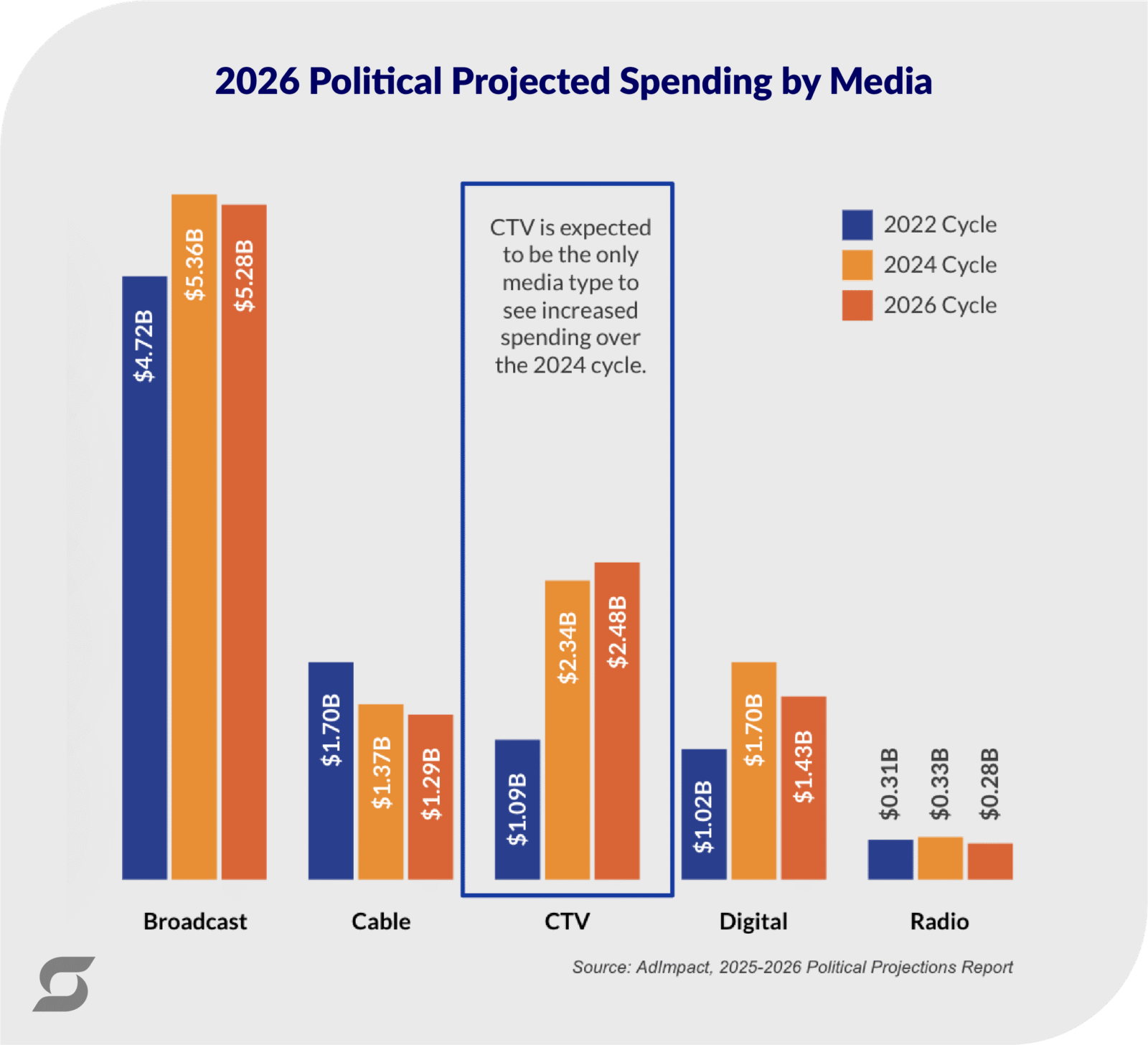
Traditional and connected television together are projected to account for over 70% of total political ad spend in 2026.
Broadcast Television:
Broadcast TV holds the largest share at 49% ($5.3B), which is a slight increase from 2024. Despite minor revenue dips in non-election years, broadcast remains essential for large-scale statewide and local campaigns.
Connected TV (CTV):
CTV is expected to grow to 23% of total political ad spending, adding $124M in incremental spend. We are seeing campaigns leaning into precision targeting and data-driven delivery to complement linear TV.
Political lobbyists remain desperate to get more access. However, significant streaming platforms like Netflix, Prime Video, and Disney+ do not allow political ads. This limits the available CTV inventory and raises competition in other areas.
Battleground States and Local Market Pressure
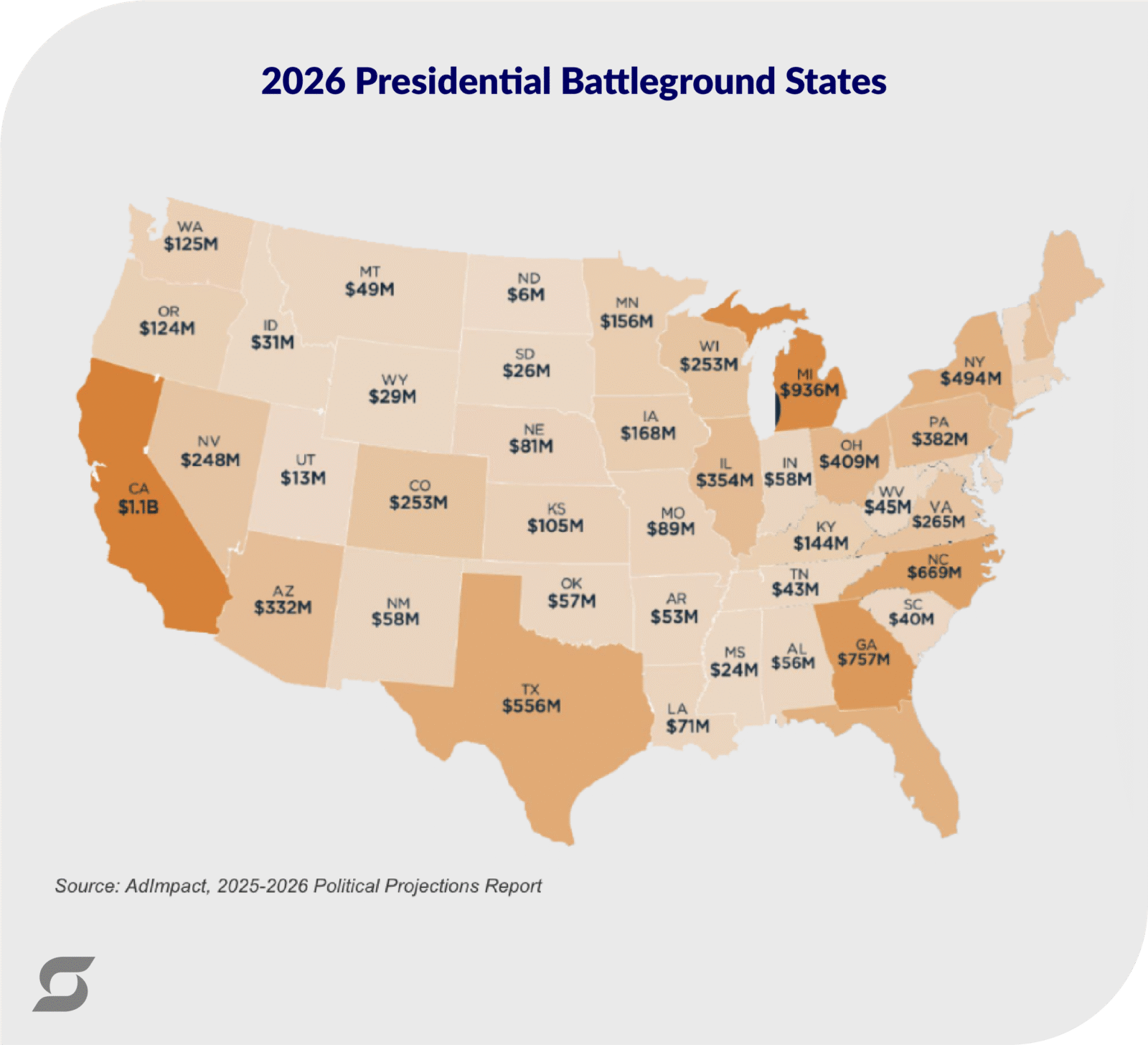
Political ad spending will not be evenly distributed. Battleground states and competitive local markets will experience the greatest pressure on inventory and pricing.
Projected Top Political Ad Spending States in 2026
- California: ~$1.1B, driven by numerous costly ballot initiatives
- Georgia, Michigan, New York, North Carolina, Texas: Each nearing $500M
- Illinois, Ohio, Virginia: Potential for sharp increases if races tighten
- Arizona, Nevada, New Jersey: Elevated spending from crowded House races
Each DMA behaves differently depending on the election cycle. For example:
- Chicago historically peaks during the Midterm elections
- Charlotte tends to surge during Presidential cycles
In the last Midterm election, 35% of Chicago’s total spending on political TV ads happened in October. This made up 64% of all TV spending that month. These dynamics make local, market-by-market planning critical.
How Political Ads Impact Key Media Channels
Political advertising affects each media channel differently. Here’s Scale’s perspective on what to expect in 2026:
Linear TV
Heavy CPM inflation and preemptions are expected, especially in battleground DMAs. News and sports programming will be most impacted, with October representing peak pressure.
Connected TV (CTV)
Political CTV spend is projected to exceed $2.5B, driving CPM increases in late Q3 and Q4. Linear spillover will add pressure, making upfront or guaranteed buys increasingly important.
Radio
Radio faces moderate political impact compared to TV, with the greatest pressure in battleground states and news/talk formats. This channel remains a strong reach option, especially when TV inventory faces constraints. Early booking is key for radio.
Search
Search generally sees limited CPC impact, but YouTube and Performance Max video campaigns face increased competition. Protecting brand terms and separating video budgets helps avoid cannibalization.
Social Media
Election windows drive 5–15% CPM increases nationwide, with 40–50% increases in battleground markets. Meta is most affected, while TikTok tends to experience less political pressure. Flexibility in budgets and targeting is essential.
Programmatic & Streaming Audio
Programmatic CPMs rise in news-heavy and battleground inventory. Streaming audio, especially podcasts, can see a 10–20% increase in CPM. It is still a good way to raise awareness during political noise.
Scale Marketing’s 2026 Political Strategy & Process – Setting for Success
At Scale, we plan for election cycles well in advance to protect performance and maintain momentum. Here are a few ways we help insulate brands from political ad pressure:
- Fixed TV Sponsorships: Visibility outside traditional breaks, even when spot inventory is crowded with political ads
- CTV, Social & Programmatic Diversification: Leveraging platforms with fewer political restrictions and greater flexibility.
- Radio: Lower political saturations with consistent weekly reach
- Out-of-Home: Billboards, digital, and transit placements that sustain visibility when TV clutter peaks
The 2026 Midterm election will see record spending on political ads. More competition and pressure on prices will arise in important media channels. With careful planning, variety, and understanding of the market, brands can keep growing, even in tough competition. At Scale Marketing, we help brands prepare for change. We help our clients adapt quickly and stay visible when it matters. We connect strategy, media, and measurement. This way, performance stays clear, accountable, and strong.